





<img alt="" src="https://secure.weed6tape.com/193471.png" style="display:none;">
About
About
Learn more about our mission, explore career opportunities, and access our resources. Discover how we’re shaping the future of cybersecurity and how you can be part of it.
Contact us
  • There are no suggestions because the search field is empty.

Challenge

Cryptographic keys are the foundation of digital trust. Yet as enterprises expand into hybrid and multicloud environments, key management becomes increasingly fragmented. They are distributed across different platforms, services, and environments — each with its own management tools, interfaces, and processes.

Many enterprises still rely on command-line tools, isolated APIs, or vendor-specific services to manage key lifecycles. This approach increases operational complexity, limits visibility into key usage, and makes it difficult to enforce consistent policies across environments. At the same time, regulatory frameworks such as PCI DSS, GDPR, and financial industry standards require strict control over cryptographic assets, clear separation of duties, and full auditability.

As key volumes scale into the millions and infrastructures become more dynamic, organizations need more than just secure storage. They need a solution that combines HSM-level security with usability, transparency, and centralized governance — without adding infrastructure complexity.

Solution

CyberVault KMS (Key Management System) is a centralized, browser-based platform for managing the complete lifecycle of cryptographic keys across Primus CyberVault HSM and Securosys CloudHSM deployments.

It combines key governance, certificate management, policy enforcement, audit logging, and multi-approval workflows within a single, hardware-backed environment. All keys are generated and protected inside FIPS 140-2 Level 3 (140-3 in certification) and Common Criteria EAL4+ certified HSMs, ensuring that every key remains protected by a certified hardware root of trust.

Through its integrated REST interface, KMIP Server (1.0–3.0), and standard application APIs such as PKCS#11, JCE, and MS-CNG, CyberVault KMS enables centralized key lifecycle management for databases, storage and backup systems, disk and volume encryption, cloud BYOK/HYOK strategies, container platforms, virtualization environments, and enterprise applications.

Whether securing Transparent Database Encryption (TDE), integrating KMIP-compliant storage, or enforcing governance across multicloud deployments, CyberVault KMS provides a unified, scalable, and fully auditable key management platform.

Explore the detailed use cases below to see how CyberVault KMS supports each deployment scenario.

Securosys KMS - Architecure

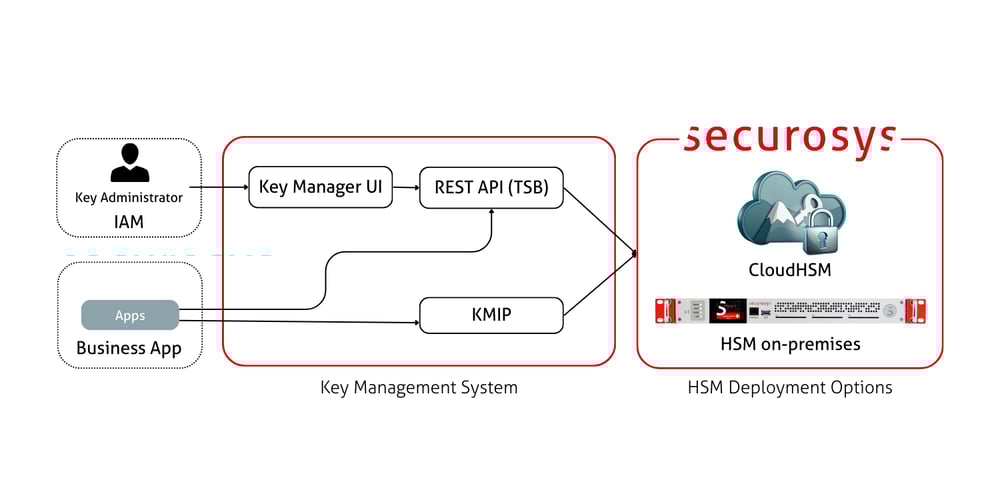
CyberVault KMS Architecture

Key Benefits

vault-b&w
Hardware-Native Security
Keys are generated, stored, and processed inside FIPS 140-2 Level 3 (140-3 in certification) and Common Criteria EAL4+ certified HSMs.

locket-circle-blocks-b&w
Unlimited Scalability
Designed for enterprise growth, CyberVault KMS supports up to 4+ millions of keys per cluster without artificial limits on keys, clients, or connections.

blocks-lock-b&w
Modern, Intuitive UI
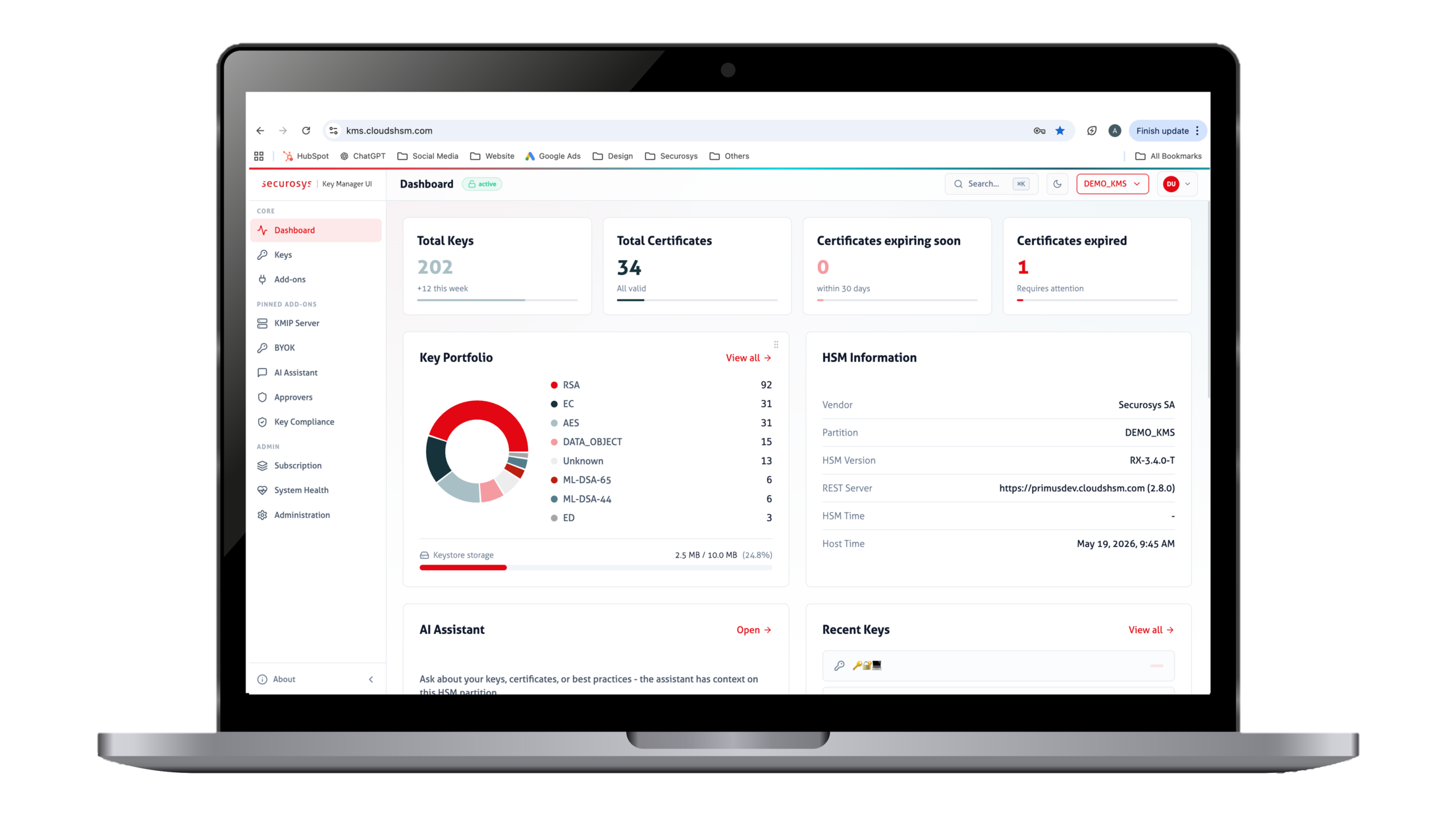
Central dashboard for managing keys, partitions, users, certificates, and policies — without CLI complexity.
key-circle-people-b&w
Multi-Approval Workflows (SKA)
Integration with Smart Key Attributes (SKA) enforces separation of duties with secure multi-party authorization.
API-circle-b&w
Full Lifecycle Visibility
Built-in health monitoring identifies expiring certificates, unused keys, weak configurations, and compliance deviations.

map-sphere-b&w
Enterprise-Ready Integration
Native support for REST, KMIP, PKCS#11, JCE, and MS-CNG ensures seamless integration across applications, storage, databases, virtualization platforms, and cloud services.
blocks-b&w-3
Deploy in Minutes
Built on a container-based architecture, CyberVault KMS can be deployed quickly in Docker or Kubernetes environments. Its lightweight design simplifies rollout across on-premises, hybrid, and cloud infrastructures.

Use Cases

colourful-background-patterns-14 Database Key Management Centralized key management for Transparent Database Encryption (TDE). Manage master encryption keys for enterprise databases while maintaining separation between key management and database administration.
colourful-background-patterns-13 Disk & Volume Encryption Key management for Linux Unified Key Setup (LUKS) and full-disk encryption solutions. Centrally manage encryption keys for servers, workstations, and storage volumes with policy-based lifecycle control.
colourful-background-patterns-9 Storage & Backup Encryption (KMIP) KMIP-compliant key management for SAN and NAS storage arrays, self-encrypting drives, tape libraries, and backup solutions. Industry-standard protocol enables seamless integration with enterprise storage infrastructure.
colourful-background-patterns-11 Cloud Key Management (BYOK/HYOK) Bring Your Own Key (BYOK) and Hold Your Own Key (HYOK) for cloud service providers. Generate keys on-premises in HSMs and maintain full lifecycle control while leveraging cloud encryption services.
colourful-background-patterns-13 Containers & Virtualization Key management for container orchestration platforms (etcd encryption, secrets management) and virtualization environments (VM encryption, virtual SAN). Secure containerized and virtual workloads at scale.
colourful-background-patterns-2 Application Security REST API, PKCS#11, JCE, and MS-CNG interfaces for application integration. Enable custom encryption, signing, and cryptographic operations with centralized key governance and comprehensive audit trails.

Securosys - CyberVault KMS (1)

Unified Key Lifecycle & Compliance Architecture

Technical Specifications

01
Architecture Overview
02
Technical Specifications
03
Advanced Capabilities
01
Architecture Overview
Key Manager UI
  • Web-based console for key lifecycle

  • Certificates

  • Policies

  • Approval workflows

Transaction Security Broker (TSB)

Provides robust REST API interface for seamless integration

Application APIs
  • KMIP

  • PKCS#11

  • JCE

  • MSCNG

  • REST API for application integration

  • OpenSSL

KMIP Server
  • KMIP 1.0 - 3.0 support for enterprise storage

  • Databases

  • Backup integration

Primus CyberVault HSM

FIPS 140-2 Level 3 (140-3 in certification) / CC EAL4+ compliant hardware root of trust for all cryptographic operations

02
Technical Specifications
03
Advanced Capabilities